



Research Update
Coral Reef Targeted Research & Capacity Building for Management
Over one-half
Coral
of the world's population lives
Reef
within 100 kilometres
Targeted Research &
Capacity Building for Management
of the sea.
Modelling and Decision Support Working Group
Improving coral reef management
decisions through computer modeling
Management implications
Modeling is an important
management technology that
allows decision makers and reef
users to see the dynamics of the
whole system the biophysical and
socio-economic parts. Models can
be organized so that the results
of scenarios of `what if' questions
can be computed and visualized
immediately.
The purpose of the Coral Reef
Targeted Research & Capacity
Building for Management
Program's Modelling and Decision
Support Working Group (MDSWG)
is to create an integrated scientific
understanding of the way in which
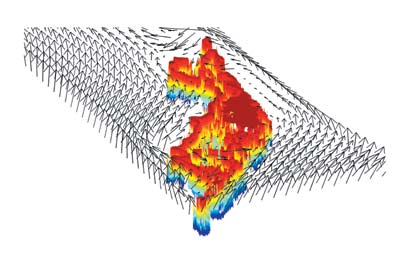
The estimated bathymetry (or bottom topography) to
people interact with coral reefs.
The problem
30m around the major island group of Palau. The darkest
The Coral Reef Targeted Research &
Coral reefs and the people that
The MDSWG research aims to
red represents land and the top of the barrier reef,
Capacity Building for Management
depend on them have a big
while blue indicates 30m deep water. The bathymetry
Program (CRTR) is a leading
develop modelling resources to
was produced using satellite data combined with
international coral reef research
problem: The problem of lots of
enable reef managers to work
measurements in the field. Surface currrents typical for
initiative that provides a coordinated
problems crashing together.
approach to credible, factual and
with simulations for their own
the Decemenr-March period are illustrated by the vectors
scientifically-proven knowledge for
areas, better understand the links
And what problems they are!
improved coral reef management.
between local, regional and global · Global problems like climate
And they can't be solved in one
The CRTR Program is a proactive
processes and access realistic
research and capacity building
change and mass tourism.
place and not another, because
partnership that aims to lay the
scientific and economic data over
coral reefs are connected
foundation in filling crucial knowledge
the Internet.
· Regional problems like
gaps in the core research areas of Coral
overfishing and agricultural
· By ocean currents
Bleaching, Connectivity, Coral Diseases,
Coral Restoration and Remediation,
runoff.
> Sewerage diverted from one
Remote Sensing and Modelling and
Decision Support
· Local problems like sewerage
reef will affect another;
Each of these research areas are
pollution and dredging.
> Overfishing on one reef
facilitated by Working Groups
depletes its neighbours of new
underpinned by the skills of many of the
These problems can't be solved
world's leading coral reef researchers.
baby fish.
one at a time
The CRTR also supports four Centers of
Excellence in priority regions, serving as
· By regional economic processes
· Because while we try to solve one,
important regional centers for building
confidence and skills in research,
the others wil just get worse (e.g.
> Closing one reef to fishing
training and capacity building.
a dol ar spent on overfishing is a
shifts the pressure to other
The CRTR Program is a partnership
dol ar not spent on climate change).
reefs.
between the Global Environment
Facility, the World Bank, The University
· And because solving one can
· And by global markets
of Queensland (Australia), the
United States National Oceanic and
actually make another worse
> Industrial fishing and mass
Atmospheric Administration (NOAA) and
(e.g. fixing agricultural pollution
tourism destroy reefs in one
approximately 40 research institutes &
other third parties around the world.
from the hinterland can increase
area and then move on to new
sewerage pollution from the city
ones.
October 2006
by shifting populations).
www.gefcoral.org
Research Update
Coral Reef Targeted Research & Capacity Building for Management
Is there a solution?
A real solution to the coral reef
problem must:
· Attack all the problems
simultaneously;
· Understand how local problems
affect global problems and vice
versa;
· Understand how social and
economic problems affect
biological and physical problems eil
and vice versa;
W
· Explore the effects of different
Ernesto
management strategies on all
ge:
Ima
problems; and;
· Allow managers to learn and
Goals
Progress to date
adapt.
We are building a series of
We have built and tested the
computer simulations of coral reefs fundamental `engine' to drive the
to help managers make better
simulations.
decisions:
· One part of this engine captures
· We are working with managers, at
the way coral reefs work the
local, regional and global levels,
biology and physics.
to make sure these simulations
· The other part captures the way
are relevant to their needs.
eil
people use reefs the economics
W
The simulations capture the way
and sociology.
oup
reefs work:
Ernesto
ge:
· How they grow under normal
Ima
conditions;
orking Gr
· How they collapse in response to
stresses and pressures, and;
· How they interact with the human
eef management decisions
communities that use them.
· They are `flight simulators' for
te
coral reef managers.
Importantly, these simulations will
upda
allow managers to look at reefs
locally, regionally and globally,
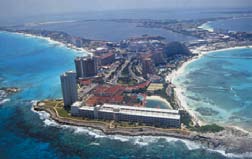
Aerial photograph of hotel development in Cancun,
· So that the full effects of
Mexico adjacent to coral reefs
© Wolcott Henry 2001
oving coral r
eil
W
management decisions can
ough computer modeling
become apparent.
Ernesto
We are now working on simulations
ge:
> That is, so that the effects of
Modeling and Decision Support W
Impr thr - research
Ima
global management decisions, · That managers themselves can
say to do with global warming,
`drive';
Further Information
can be related to the effects of
· That work at local, regional and
Modelling and Decision Support
local management decisions,
global scales.
Working Group
such as declaring an MPA.
Australian National University
Chair: Dr Roger Bradbury
Email: roger.bradbury@anu.edu.au
Co-Chair: Dr Pascal Perez
Email: pascal.perez@anu.edu.au
Project Executing Agency:
Coral Reef Targeted Research &
Capacity Building for Management
Program
C/O Centre for Marine Studies
The University of Queensland
St Lucia QLD 4072
Australia
Telephone: +61 7 3365 4333
Facsimile: +61 7 3365 4755
Email: info@gefcoral.org
www.gefcoral.org